Your Locality’s TDS Changes Everything – How to Pick the Right RO for Delhi NCR Borewell Water
Looking for the best RO for high TDS water in Delhi NCR? Your locality’s TDS level matters more than your city!
So you live in Delhi NCR. Your know your water is hard. You also know that you really need an RO. You’ve spent the better part of two weeks speaking to friends, reading online reviews, browsing Amazon listings and getting contradictory advice from every WhatsApp group you’re in!
Here’s the problem: every recommendation you’ve received was probably right – for someone else’s house.
You see…Delhi NCR borewell TDS ranges from 300 ppm in parts of Gurugram to over 1,800 ppm in Najafgarh and Ballabhgarh. That’s not a small gap. It’s the difference between a standard RO working fine and a membrane failing inside 12-18 months.
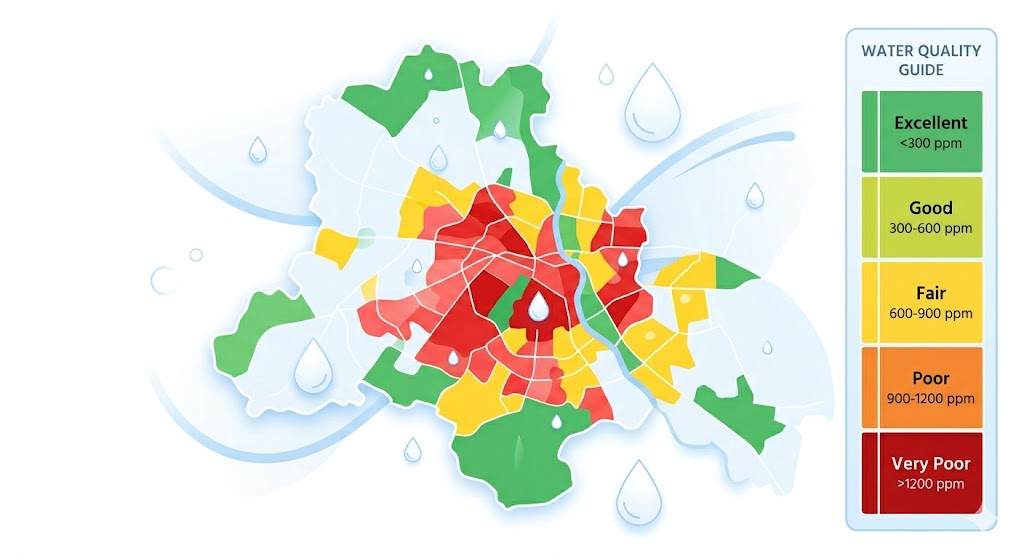
The table below is the fastest way to see where your locality sits – and whether your current or shortlisted RO is actually designed for it.
Your Locality, Your TDS – Does Your RO Match?
Data source: Ion Exchange India / IJEAST 2024 – 41 Delhi NCR localities, borewell readings.
| Locality | Borewell TDS (ppm) | Zone | Is your current RO rated for this? |
|---|---|---|---|
| Gurugram Sector 14–22 | 300–500 ppm | Low | Yes — any standard RO handles this |
| Noida Sector 62 | 350–550 ppm | Low | Yes — standard RO is fine |
| Faridabad Sector 15 | 400–600 ppm | Low-Medium | Likely yes — verify your RO's rated TDS |
| Rohini (Delhi) | 600–900 ppm | Medium | Only if rated above 900 ppm input TDS |
| Dwarka (Delhi) | 700–1000 ppm | Medium | Check — many budget ROs fail here |
| Ghaziabad Indirapuram | 700–1100 ppm | Medium-High | Not if it's a basic 200/400 GPD model |
| Noida Sector 137 | 800–1200 ppm | High | No — needs a high-TDS rated model |
| Burari (Delhi) | 1200–1600 ppm | Very High | No — most standard ROs will fail early |
| Najafgarh (Delhi) | 1400–1800 ppm | Very High | No — membrane lifespan drops sharply |
| Ballabhgarh (Faridabad) | 1500–2000 ppm | Extreme | No — you need a high-rejection membrane |
Green = standard RO adequate. Yellow = check your model’s rated input TDS. Red = standard RO will struggle or fail early.
Don’t see your locality? Jump to the full 20-locality table near the bottom of this article.
Why Your Neighbor’s Recommendation Doesn’t Apply to You
When someone in your housing society WhatsApp group recommends a water purifier, they’re recommending what works for either their exact water quality or what they have been using thus far. That’s borewell water from the same aquifer, drawing from the same depth, through the same pipes – or municipal supply from the same source.
Move just three kilometres away and the ground water aquifer changes. TDS can shift by 400–600 ppm across adjacent sectors in Noida or Gurugram. A model perfectly adequate in Sector 62 (350–550 ppm borewell) can be genuinely underpowered in Sector 137 (800–1,200 ppm).
RO membranes are rated for a maximum input TDS. Push them significantly above that number, and you’re not just getting slightly worse purification – you’re reducing membrane lifespan, increasing water waste, and producing output TDS that doesn’t meet safe drinking standards.
The neighbor whose purifier “works great” may be on 450 ppm municipal supply. You may be on 1,400 ppm borewell. Different problem, different solution.
What High TDS Actually Does to Your RO
Most buyers focus on output TDS – how clean the water is after purification. The bigger issue in high-TDS areas is what happens inside the system.
Membrane Stress
RO membranes work by pushing water through a semi-permeable barrier under pressure. The more dissolved solids in your input water, the more pressure is actually required and the harder the membrane works per litre filtered. Sustained input TDS above your membrane’s rated range accelerates fouling and physical degradation of the membrane.
Shortened Service Life
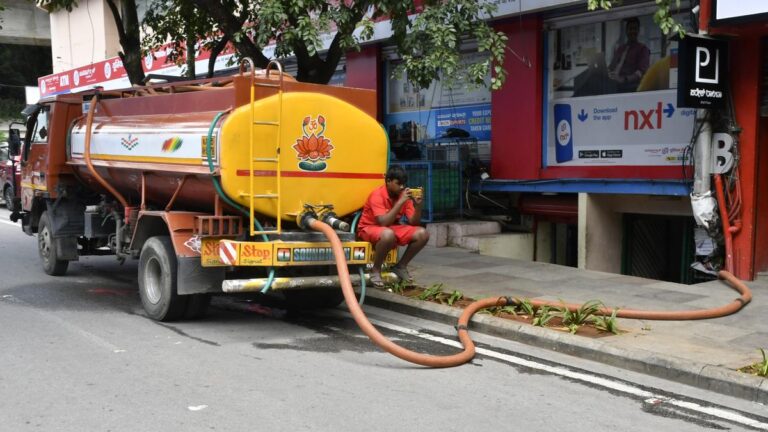
In areas like Burari or Ballabhgarh (1,200–2,000 ppm borewell), a membrane rated for standard use at 500–600 ppm input can fail in as little as 12 months instead of the 2–3 years it’s designed to last. You end up spending ₹2,000–3,500 on replacement membranes far ahead of schedule.
Output TDS Creep
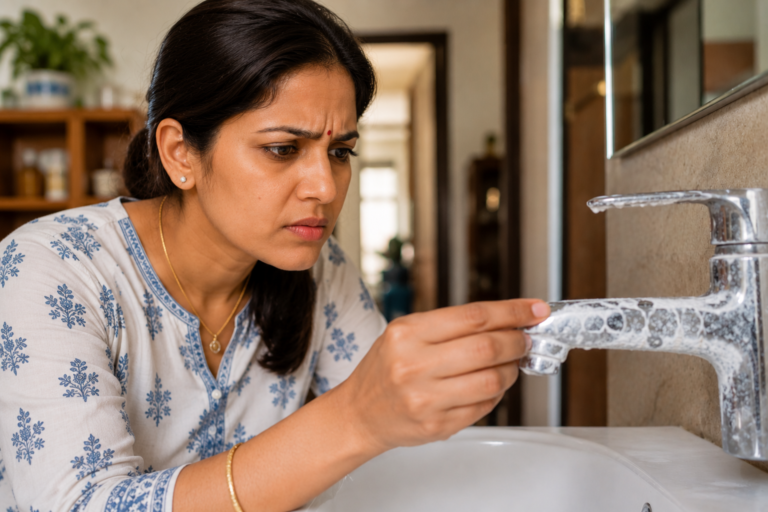
A membrane working at the edge of its capacity doesn’t fail all at once. It degrades gradually, letting more and more dissolved solids through. Your output TDS drifts upward over months – often without triggering any visible alarm – until the water you’re drinking is no longer adequately purified.
Waste Water Ratio Climbs
High-input-TDS water also worsens your waste-to-output ratio. Standard ROs reject 3 litres of water for every 1 litre produced. At 1,500+ ppm, that can approach 4:1 or worse on a membrane not optimized for the load.
What Is MTDS?
Full RO vs MTDS: Which One Actually Protects Your Family?
What Your Water Demands by TDS Band
Before looking at specific models, understand what each TDS band actually requires from a purifier.
300–600 ppm: Standard RO Territory
This is manageable water. A properly spec’d RO will purify it efficiently, deliver acceptable output TDS (typically under 100 ppm post-treatment), and give you normal membrane life.
What matters here: MTDS or TDS control valve, so minerals aren’t stripped completely. Waste ratio. After-sales service reliability in your area.
Most Gurugram sectors and parts of Noida (Sector 62 area) fall here.
600–1,200 ppm: Check Your Model’s Rated Capacity
This is where most buyer mistakes happen. The water looks similar, the symptoms aren’t obvious, but generic budget ROs start showing membrane stress within 18–24 months. You need a model that’s explicitly rated for higher input TDS – not just marketed as “high TDS” but certified for it.
Much of Rohini, Dwarka, Ghaziabad (Indirapuram, Vaishali), and parts of Faridabad fall here.
1,200–2,000 ppm: Specialist Territory
Standard ROs should not be used here. The membrane technology, pressure handling, and waste management all need to be designed for this input range. Purifiers in this band typically use higher-rejection membranes with rated input capacity clearly specified in their technical documentation.
Burari, Najafgarh, Ballabhgarh, and parts of Shahdara fall here. If your locality is in this range and you’re using a budget RO, check your output TDS today.
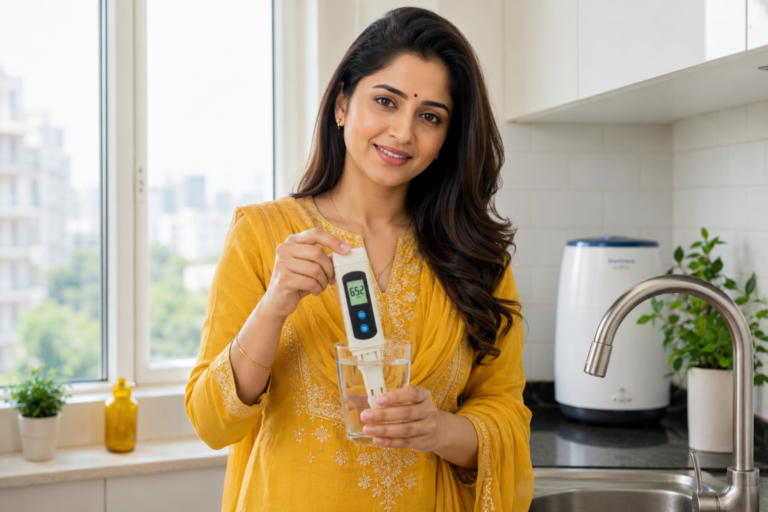
Quick test: Buy a TDS pen (₹300–500 on Amazon). Measure your tap water before the purifier. Then measure output. If output is above 100 ppm consistently, your membrane is working harder than it should – or already degraded.
🔍 Know your locality TDS? Let the ROI Engine match you to the right purifier in 60 seconds. → Take the ROguru Quiz (roguru.in)
The Best ROs for High TDS Water in Delhi NCR — By TDS Band
| TDS Band | Recommended RO | Why it fits |
| 300–600 ppm | Strong rejection at moderate loads; MTDS blending preserves minerals; manageable waste ratio | |
| 600–1,200 ppm | Rated for higher input TDS; good membrane longevity; certified for this range | |
| 1,200–2,000 ppm | High-rejection membranes; built for extreme borewell loads; lower waste-to-output ratio matters here |
Recommendations are independent – no brand pays for placement. Based on certified input TDS ratings, membrane longevity data, service network in NCR, and 5-year total cost of ownership.
300–600 ppm: Aquaguard Ritz Pro | Amazon Link
Strong fit for moderate-TDS Delhi NCR homes. In the ROguru database, Aquaguard Ritz Pro is listed for input TDS up to 1000 ppm, making it suitable for the 300–600 ppm range with room to spare. Its remineralization setup helps restore minerals after RO purification, and the Aquaguard service network is a practical advantage across many NCR areas.
300–600 ppm: Livpure Allura Premia | Amazon Link
A strong lower-to-mid TDS option for homes around the 300–500 ppm range. Livpure Allura Premia is listed for Delhi in the ROguru database, supports UV+UF along with RO, and includes remineralization plus anti-scalant treatment. It is a good choice for smaller households or buyers who want a balanced value option without overbuying for very high TDS.
600–1,200 ppm: Urban Company Native M1 | Amazon Link
A strong fit for Delhi NCR homes in the 600–1,200 ppm range. In the ROguru database, Native M1 is listed for Delhi and rated up to 2000 ppm input TDS. Its strongest advantage is the combination of 100% RO purification, post-remineralization, 8L storage, and the “no service for 2 years” proposition, which can reduce early ownership anxiety.
600–1,200 ppm: Pureit Eco Elite 2X | Amazon Link
A strong option for higher-mid TDS homes, especially where storage capacity and water saving matter. Pureit Eco Elite 2X is listed for Delhi and rated up to 2000 ppm in the ROguru database. It has 10L storage, remineralization, and 100% RO filtration with mineral addition, making it a practical choice for families in the 800–1,200 ppm range.
1,200–2,000 ppm: Pureit Eco Water Saver | Amazon Link
A strong high-TDS choice because the database explicitly notes 100% RO with no bypass and input TDS handling up to 2000 ppm. At 1,200+ ppm, no-bypass RO logic matters because you want the full water stream going through the RO membrane before minerals are added back. Its 10L storage and water-saving positioning also make sense for Delhi NCR homes dealing with hard borewell or tanker water.
1,200–2,000 ppm: AO Smith Z5 Pro | Amazon Link
A strong alternate for high-TDS homes, especially smaller households. AO Smith Z5 Pro is listed for Delhi and rated up to 2000 ppm in the ROguru database. It brings copper/mineral enhancement and strong TDS reduction, but its 5L storage means it is better suited to smaller families or homes with moderate daily drinking-water demand.
Full Delhi NCR Locality TDS Reference Table
All readings from Ion Exchange India / IJEAST 2024 study of Delhi NCR borewell water (41 localities). TDS and hardness figures represent typical observed ranges – your exact readings may vary by building depth and season.
| Locality | Borewell TDS (ppm) | Hardness (mg/L CaCO₃) | Recommended TDS Band |
|---|---|---|---|
| Gurugram Sector 14–22 | 300–500 | 120–200 | 300–600 ppm band |
| Gurugram Sector 57–67 | 400–600 | 150–250 | 300–600 ppm band |
| Gurugram DLF Phase 1–5 | 350–550 | 130–220 | 300–600 ppm band |
| Noida Sector 62 | 350–550 | 140–230 | 300–600 ppm band |
| Noida Sector 137 | 800–1200 | 300–500 | 600–1200 ppm band |
| Noida Sector 150 | 700–1100 | 280–460 | 600–1200 ppm band |
| Noida Extension (Greater Noida West) | 900–1300 | 350–550 | 600–1200 ppm band |
| Greater Noida (main) | 600–950 | 220–380 | 600–1200 ppm band |
| Faridabad Sector 15–21 | 400–600 | 160–260 | 300–600 ppm band |
| Faridabad Sector 86–88 | 700–1000 | 280–460 | 600–1200 ppm band |
| Ballabhgarh | 1500–2000 | 600–900 | 1200–2000 ppm band |
| Rohini (Delhi) | 600–900 | 220–380 | 600–1200 ppm band |
| Dwarka (Delhi) | 700–1000 | 260–420 | 600–1200 ppm band |
| Burari (Delhi) | 1200–1600 | 480–750 | 1200–2000 ppm band |
| Najafgarh (Delhi) | 1400–1800 | 550–820 | 1200–2000 ppm band |
| Uttam Nagar (Delhi) | 800–1200 | 320–520 | 600–1200 ppm band |
| Shahdara (Delhi) | 900–1300 | 360–560 | 600–1200 ppm band |
| Ghaziabad Indirapuram | 700–1100 | 280–460 | 600–1200 ppm band |
| Ghaziabad Vaishali | 650–950 | 250–420 | 600–1200 ppm band |
| Ghaziabad Raj Nagar Extension | 800–1200 | 310–510 | 600–1200 ppm band |
Note: Municipal supply TDS is typically 50–200 ppm across Delhi NCR – significantly lower than borewell. If you’re on municipal supply, your RO selection logic changes. See: Do You Need an RO for Delhi Municipal Water? (A010, coming soon).
Don’t Know Your Locality’s TDS? Here’s How to Find Out
You don’t need to guess.
- TDS pen test (most reliable): A basic TDS meter costs ₹300–500 on Amazon. Fill a clean glass directly from your tap (not post-filter), measure, and you have your number in 10 seconds.
- Ask your RO technician: Any technician servicing your area will have a rough sense of local borewell TDS. Ask during the next service call.
- Check the locality table above: The Ion Exchange data covers 20 major NCR localities. If yours is listed, use it as a starting benchmark.
- Housing society water testing reports: Many larger societies commission water quality reports annually. Check with your RWA or maintenance office.
Once you have your TDS number, come back to this article, find your band, and go straight to the recommended ROs for it.
The One Thing to Remember
Every purifier brand will tell you their product handles Delhi NCR water. Most of them are right – for some parts of NCR. But not all parts, and not all water.
You now know what your water demands. The only question left is which is the best RO for high TDS water in Delhi NCR that delivers it for your specific locality.
Your locality’s TDS is the single most important number in your buying decision. Not the brand. Not the marketing. Not what worked for someone three buildings away.
Know your number. Match your purifier to it. Everything else is secondary.
🔍 Answer 6 questions. Get the right RO for your exact water – in 60 seconds.
→ Take the ROguru Quiz at roguru.in