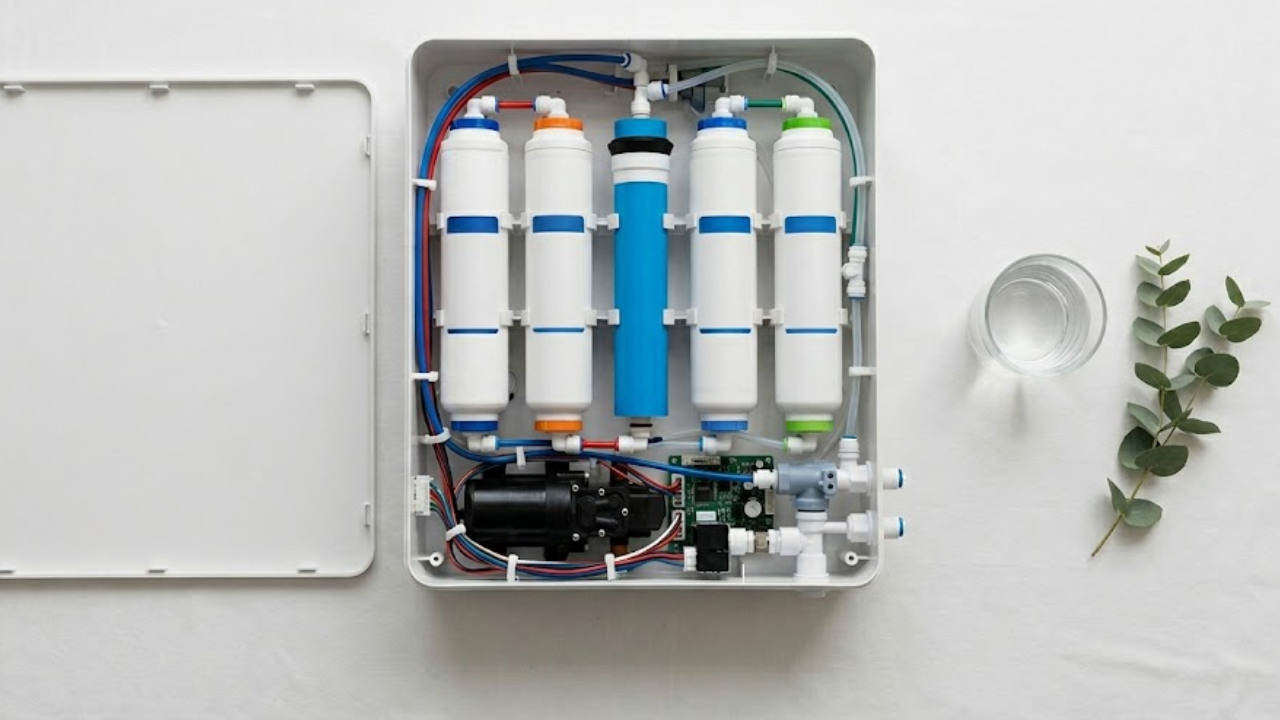
What Is MTDS in Your RO Purifier? And Why Your Technician Might Not Tell You the Full Story!
Published by ROguru · Bangalore · May 2026
MTDS in RO purifier systems is one of the least understood settings and one of the most important. If you own a purifier in Bangalore, there is a good chance someone has adjusted this setting without ever explaining what it does to your water.
What Is MTDS in RO Purifier? The Plain Language Answer
MTDS stands for Manual Total Dissolved Solids controller. It is NOT a filter. It DOES NOT purify water. It is a small little valve inside your RO water purifier machine that controls how much unfiltered water gets mixed back into your purified output.So, here is why it really exists.You see, an RO membrane is extraordinarily effective. It forces water through pores just 0.0001 microns wide. That is small enough to block dissolved salts, heavy metals, fluoride, nitrates and most other contaminants. The result is very clean water. Sometimes too clean, at least by one measure: the taste.
When TDS drops below roughly 50 ppm, water starts to taste flat, slightly metallic, even bitter. This is not a health problem per se but it is a perception problem. Consumers complain about the taste or lack there of. Brands’ customer service get called. Technicians arrive.
The MTDS valve is the water purifier industry’s answer to the taste complaint. By mixing a controlled stream of pre-filtered (but not RO-purified) water back into the clean output, the TDS rises, the taste improves, and the complaint stops.
That is the legitimate version of the MTDS story. But wait! There is another version.
How MTDS Works? The Circuit You Need to Understand
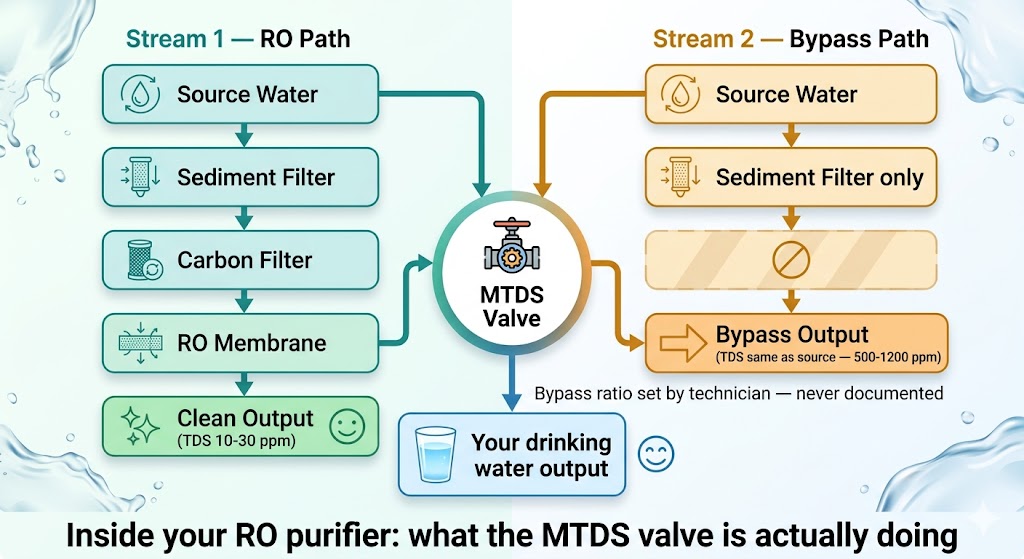
Inside an RO purifier with MTDS, incoming water is split into two streams before purification:
Stream 1 – The RO path: Water passes through sediment filters, pre-carbon filters and then the RO membrane. This stream removes dissolved salts, heavy metals, fluoride, nitrates, arsenic, and microbial contaminants. Output TDS can drop to as little as 10–30 ppm from an input of 500–1000 ppm.
Stream 2 – The bypass path: Water passes through a sediment filter and sometimes a carbon filter, but bypasses the RO membrane entirely. It retains dissolved minerals and everything else dissolved in your source water.
The MTDS valve actually blends these two streams. A screw or dial controls the ratio. Turn it one way and more bypass water enters the output, raising TDS. Turn it the other way and less enters, lowering TDS.
The critical fact you must understand is this: The bypass stream is not RO-purified. Whatever is dissolved in your source water that only an RO membrane can remove …the heavy metals, fluoride, nitrates, arsenic…all still remain in the bypass stream. When that stream blends into your output, those contaminants come with it.
Better-designed machines route the bypass stream through a UF (Ultrafiltration) or MF (Microfiltration) membrane before blending. This removes biological contaminants and some heavy metals. But UF pore sizes (0.01–0.1 microns) are still a hundred times larger than RO pores. They cannot remove dissolved salts or most dissolved heavy metals. Additionally, many budget RO purifiers on the Indian market do not include post-MTDS UV treatment… meaning the blended output is never disinfected after mixing. This is a critical safety gap.
Why Your TDS Reading Is Not the Whole Story
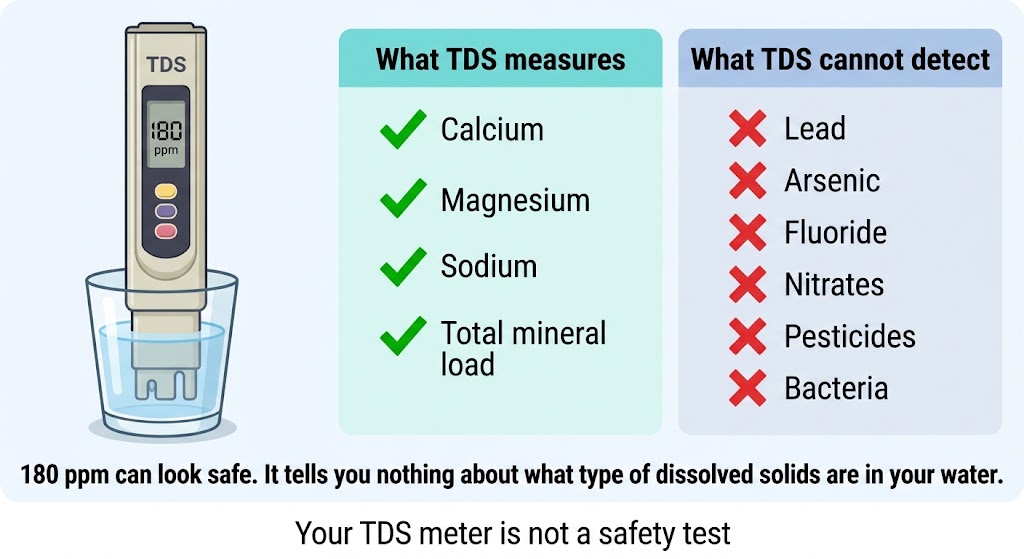
Most people understand TDS as a safety metric. The logic goes: high TDS = bad water, low TDS = safe water. This is the framing that brands, technicians, and even government communications often use.
It is incomplete, and for example, in Bangalore’s context, dangerously so.
A TDS meter measures electrical conductivity and converts it to ppm. It counts dissolved particles yes, but it cannot distinguish between calcium (harmless) and lead (toxic). It cannot detect fluoride, arsenic, pesticides, or nitrates at meaningful concentrations. Water can test at 180 ppm and still contain trace heavy metals that pose long-term health risks. Water can test at 80 ppm and be perfectly safe.
This matters because the entire MTDS logic is built on TDS as a proxy for quality. Technicians set your MTDS valve to achieve a target TDS reading in the output. That reading looks reassuring on a meter. But what it actually represents…as in which minerals were let through the bypass stream and in what concentrations is never really measured at the point of sale or during a standard service visit.
In cities like Bangalore where borewell water routinely tests at 500–1200 ppm and carries verified contamination with fluoride, nitrates, and in some areas arsenic and heavy metals, relying on TDS as a proxy for safety is a structural failure of the system.
The Bangalore Context: Why This Matters More Here
Bangalore’s water situation has changed significantly over the past decade, and the implications for anyone using an RO purifier are direct.
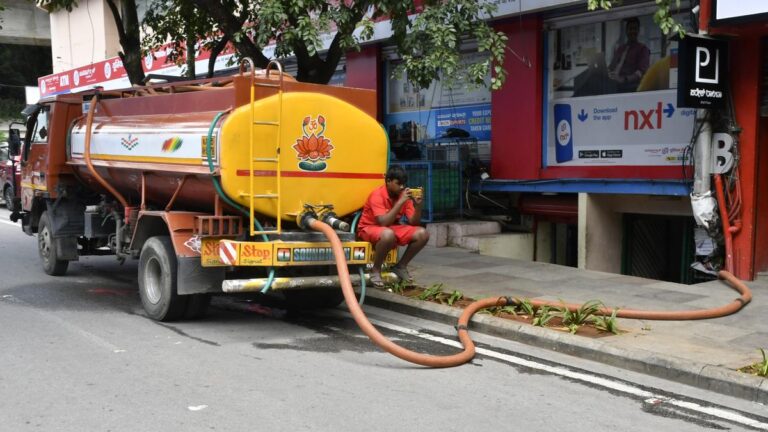
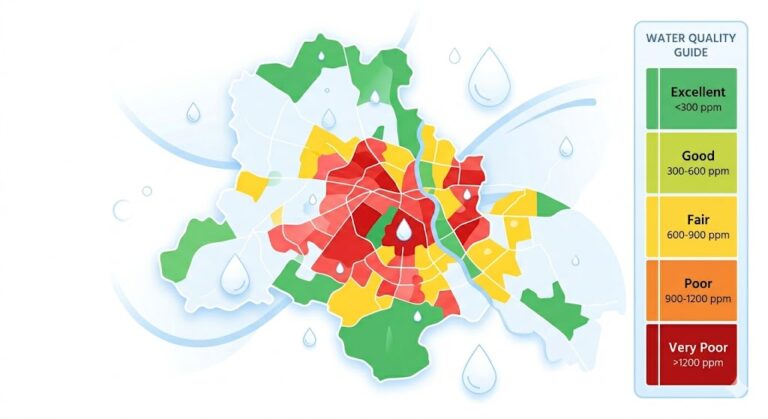
Neighborhoods like Whitefield, Bellandur, Sarjapur Road, Marathahalli, KR Puram and Hebbal depend heavily on borewells and private water tankers. Cauvery supply in these areas is either limited or inconsistent. According to Central Ground Water Authority(CGWA) data, borewell TDS in Karnataka frequently exceeds 500 ppm and reaches 1000 ppm or higher in contamination hotspots including within Bangalore’s key IT corridors.
The situation is compounded by depth. As borewells are sunk deeper in some neighborhoods to 1,500 feet, the water drawn contains more dissolved minerals, more fluoride, and in some areas radionuclides. The CGWB’s Annual Groundwater Quality Report for 2024 flagged high fluoride and uranium contamination in Karnataka groundwater.
Bellandur’s groundwater has been specifically documented to contain elevated cadmium and chromium, linked to industrial effluent percolation from Bellandur Lake. These are contaminants that only an RO membrane can address. They cannot be addressed by a bypass valve that lets a portion of that water skip the membrane entirely.
If your home runs on borewell water with TDS above 500 ppm in any of these localities and your RO purifier’s MTDS valve is open, a percentage of that contaminated source water is entering your output unfiltered by the RO membrane.
The Service Economics Problem
This is where the story gets really uncomfortable. And honestly, no one really addresses this.
An RO membrane’s job is to reject TDS. Period. By as much as 95–99% of dissolved solids. For borewell water at 1000 ppm input, a functioning membrane in good condition should produce output at 10–50 ppm. At these levels, taste suffers. Consumers notice. They call for customer service. Complain.
The technician arrives. The fastest, easiest fix is to open the MTDS valve raise the bypass ratio until the output reads 150-200 ppm and the customer is satisfied. The job takes ten minutes. ‘The complaint closes’. But the problem? Nope.
But there is a second-order consequence. With the MTDS bypass open, the full volume of source water is no longer passing through the membrane. The membrane is processing less water under less pressure. This means two things:
First, the membrane faces reduced fouling in the short term, which sounds positive. But over time, because the bypass reduces the pressure differential that keeps the membrane’s surface clean, scaling accumulates differently and membrane performance degrades in ways that is much harder to detect.
Second and more significantly: the service technician now has a perpetual reason to return. The customer’s water quality cannot be independently verified without a lab test. TDS readings, the only metric most consumers have access to… look just fine. But the actual contaminant removal is compromised every time the bypass ratio increases.
This is not a conspiracy. Well we would not blame you if you see it that way. But frankly, it is an incentive structure. Service contracts are the revenue model for most RO brands’ after-sales operations. A well-functioning machine with a clean membrane, properly maintained, on a municipal supply with TDS under 300 ppm, needs a membrane replacement every 2–3 years. A machine with aggressive MTDS settings on borewell water with TDS over 800 ppm may need more frequent intervention. The economics work differently depending on which side of the service contract you’re on.
A widely-discussed thread on reddit (r/Bangalore) surfaced this dynamic with specificity residents describing technicians adjusting MTDS settings without explanation, TDS readings that never quite reflected the machine’s actual condition, and a general opacity in what was happening inside the box during each visit.
MTDS vs Remineralization: Not the Same Thing
One of the most persistent confusions in the RO purifier category is the conflation of MTDS with remineralization. Brands, retailers, and even some technical content treat them interchangeably. They are not the same.
MTDS / TDS controller: Bypasses the RO membrane. Mixes pre-filtered (non-RO) source water back into the purified output. What minerals come through depend entirely on what is in your source water. If your source water has fluoride, a fraction of that fluoride enters your output. The ratio is set by a valve.
Remineralization / Mineral cartridge: Does not bypass the RO membrane. All water passes through the full RO circuit. After purification, a cartridge containing mineral media… typically calcite, magnesium, tourmaline or similar materials…adds specific minerals (primarily calcium and magnesium) back into the clean water. What is added is controlled and consistent. What your source water contained is irrelevant, because it was fully filtered first.
The practical difference is significant. Remineralization adds known minerals to clean water. MTDS adds a fraction of your source water with whatever that source water contains to clean water.
For municipal Cauvery supply in Bangalore, with TDS typically between 150–300 ppm and a relatively lower contamination load, MTDS is a lower-risk trade-off. For borewell water with TDS above 500 ppm and unknown heavy metal content, remineralization is the correct choice.
Brands that use remineralization cartridges instead of MTDS bypass valves include Havells and HUL Prueitt in some of their higher-end models. AO Smith uses a post-RO mineralizer in specific models. KENT and Eureka Forbes predominantly use TDS controller approaches, though product lines vary.
What Is the Right TDS for Your Drinking Water?
The target that most RO brands cite – 50 to 150 ppm – comes from a reasonable interpretation of taste and mineral balance guidelines. Here is the full picture from authoritative sources:
- WHO (World Health Organization): Recommends drinking water TDS below 300 ppm. Notes that extremely low TDS water (below 30 ppm) may have adverse metabolic effects with long-term consumption.
- BIS (Bureau of Indian Standards, IS 10500:2012): Permissible limit is 500 ppm, with a desirable limit of 500 ppm or less. The acceptable upper limit is technically 2000 ppm in the absence of alternate sources, but this is not a drinking standard.
- Practical consensus for RO-purified water: 100–250 ppm is the range most water quality experts recommend. This contains enough mineral content for taste and to avoid the concerns associated with very low TDS water, while staying well within safe limits.
The important nuance: these guidelines address TDS quantity, not composition. 200 ppm of calcium and magnesium is very different from 200 ppm that includes traces of fluoride, lead, or arsenic. The number alone is not the verdict.
The Challenge of MTDS During Installation
The problems with MTDS are not just about what happens years later. They begin at installation.
Most residential RO purifiers are installed by technicians sent by the brand or a third-party service provider. The installation process typically takes 30–45 minutes. At the end, the technician tests the output TDS with a handheld meter, adjusts the MTDS valve until the reading falls in an “acceptable” range, shows you the number, and leaves.
What you are not told during this process:
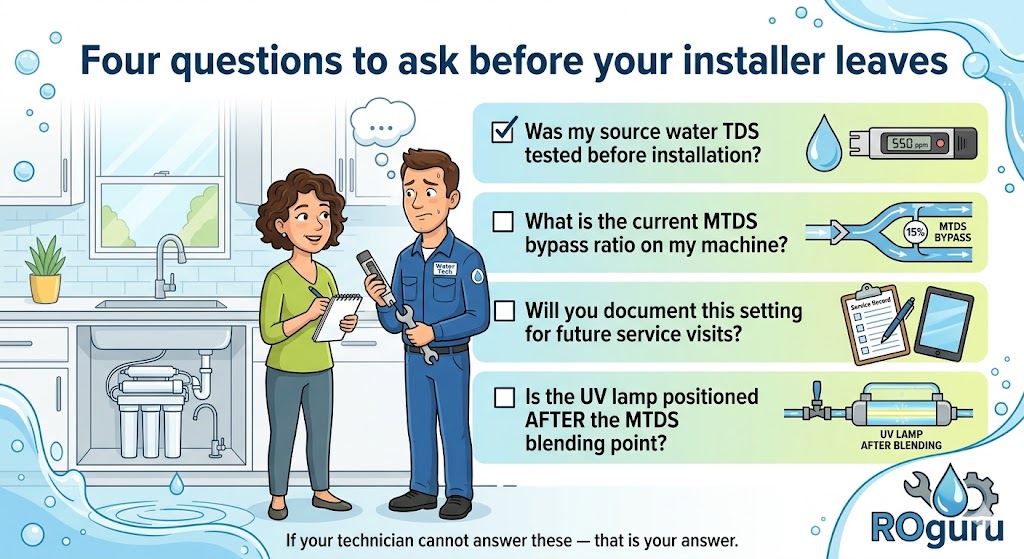
Your source water TDS was probably not tested before installation. The technician may not know whether your input is 200 ppm or 1200 ppm. The MTDS setting is adjusted to produce a target output, not calibrated to the contamination profile of your specific source.
The bypass ratio is not documented. After the technician leaves, there is typically no record of what percentage of your water is bypassing the membrane. If a different technician arrives next time, they will adjust it again based on their own judgement.
Seasonal variation is not accounted for. Borewell water TDS in Bangalore can shift significantly between summer (when aquifers are depleted and mineral concentration rises) and post-monsoon (when dilution occurs). A setting appropriate in November may be inadequate in April. Nobody comes to recalibrate.
Post-MTDS UV placement varies. Some machines position the UV lamp before the MTDS blending point. This means the bypass stream which may contain biological contaminants is never really disinfected. Check your machine’s schematic or ask your installer explicitly where the UV lamp sits in the circuit.
What to Do: A Practical Guide for Bangalore Households
Know your source water first
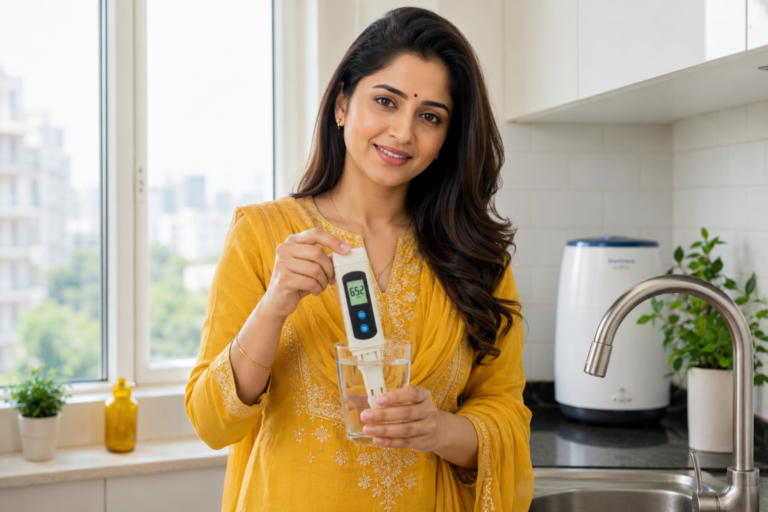
Buy a TDS meter (available on Amazon for ₹200–400). Test your tap or borewell water before it enters the purifier. This is your baseline. If your source TDS is above 500 ppm, you are in borewell or tanker territory and the decisions below apply with greater urgency.
A TDS meter will not tell you about heavy metals, fluoride, or biological contamination. For a full picture, a water quality lab test costs ₹500–2000 and is worth doing once if you are on borewell supply. BWSSB and several private labs in Bangalore offer this service.
Ask three specific questions at your next service visit
- Is MTDS enabled on my machine, and what is the current bypass ratio? A competent technician should be able to answer this. If they cannot, or if they adjust the valve without explaining why, that is a signal.
- What is my source water TDS, and is this MTDS setting appropriate for that level? The answer should reference your actual input TDS, not just the output reading.
- Where is the UV lamp positioned relative to the MTDS blending point? For machines with MTDS, UV should be after the blending point to disinfect the full output.
Understand when MTDS is and is not appropriate
MTDS is a reasonable trade-off when: your source water TDS is below 300–500 ppm, your source is municipal (Cauvery) supply with a lower heavy metal load, and the bypass stream passes through a UF membrane before blending.
MTDS is a higher-risk choice when: your source water TDS is above 500 ppm, you are on borewell or tanker supply, your source area has documented contamination (Bellandur, Whitefield, Sarjapur Road, Marathahalli, KR Puram borewells), or your machine does not have a UF stage in the bypass path.
If you are in the higher-risk category, consider a machine with a remineralization cartridge rather than MTDS, or ensure the MTDS valve is set to the minimum necessary bypass ratio.
Check your membrane, not just your output TDS
A functioning RO membrane should reduce TDS by 90–95%. If your input TDS is 800 ppm and your output (before MTDS blending) is 200 ppm, your membrane is working at only 75% rejection, it may need replacement. The only way to know this is to test the output from the membrane stage directly, before the MTDS valve blends in bypass water.
Most consumers never do this. Most technicians do not volunteer it. Ask specifically for the “post-membrane, pre-blend” TDS reading at your next service visit.
The Bigger Picture: Why ROguru Exists
The RO water purifier industry in India operates on significant information asymmetry. Brands market TDS as a health metric when it is primarily a taste metric. Technicians adjust settings that consumers cannot verify. Service contracts create incentives that are not perfectly aligned with the buyer’s long-term interest.
None of this requires bad faith from any individual. It is a structural feature of a category where the product’s performance is invisible – you cannot see, smell, or taste the difference between water with traces of fluoride and water without.
ROguru’s position is simple: the information asymmetry is the problem and closing it is our job. We want you to have the information you need to choose the best Water Filtration solution for your family. Period. Not alarm, not brand-bashin. Just pure analysis. The quiz recommendations on this site prioritize machines where the purification approach is appropriate for your specific water source and where the claim of “mineralization” means remineralization, not bypass.
If you are on borewell water in Bangalore, you deserve to know that distinction before you buy.
Summary: What to Remember
- MTDS is a bypass valve, not a filter. It raises output TDS by mixing pre-filtered source water back into purified water.
- The bypass stream bypasses the RO membrane. Whatever the RO membrane was supposed to remove – and only the RO membrane can remove – may remain in the bypass water.
- For borewell water with TDS above 500 ppm, MTDS carries a meaningful safety trade-off that is rarely disclosed at the point of sale.
- Remineralization and MTDS are not the same. Remineralization adds controlled minerals to fully purified water. MTDS adds a fraction of your source water.
- The optimal output TDS for drinking water is 100–250 ppm – but the number alone does not tell you whether the water is safe. The composition matters.
- Ask your technician three questions: Is MTDS enabled, what is the bypass ratio, and where is the UV lamp?
Not sure whether your current machine is right for your water source? Take the ROguru quiz and answer four questions about your water source, budget, and household, and get matched to machines that fit your actual situation. We only recommend machines with full RO membranes for borewell water above 500 ppm TDS.